
AI Agents and the Future of Work
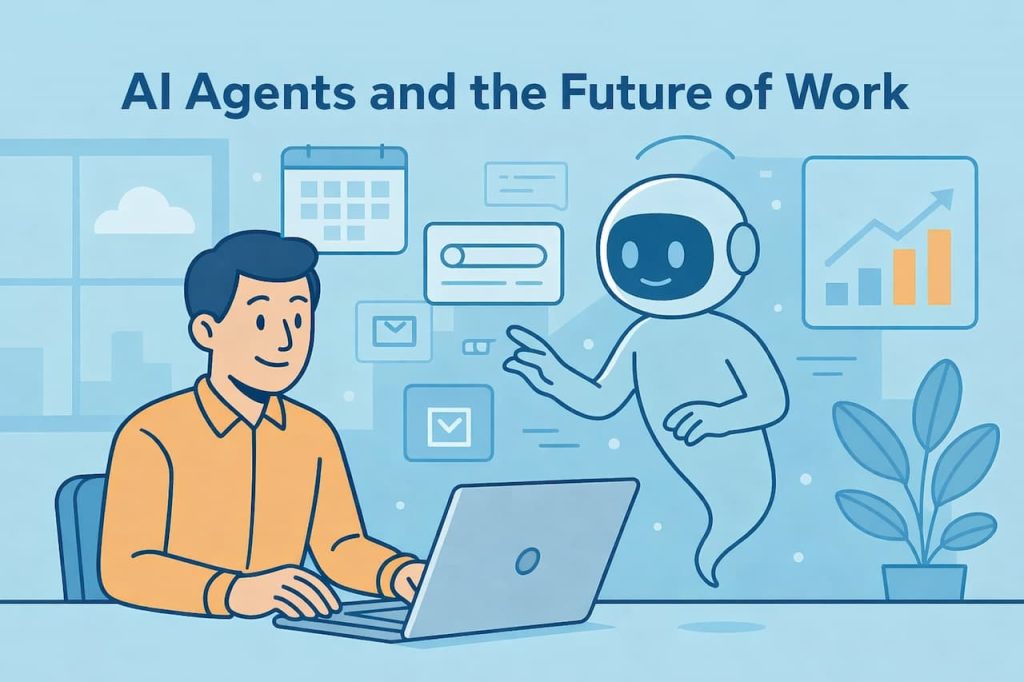
Hi, I’m Aki Matsumura from the Capacity Improvement Project Team at Hirose Paper Manufacturing.
OpenAI Unveils “Operator”!
OpenAI — the company behind ChatGPT — recently announced a new service called Operator. What makes it stand out? It can control a web browser on your behalf.
Tell it “Look up information about X,” and it opens a browser, searches, and gathers the results for you. It’s the kind of thing that used to sound like science fiction — and now it’s shipping as a product.
As of this writing (February 2025), Operator isn’t yet available in Japan. Still, the arrival of this technology signals a major shift in how we work. For companies pushing forward with digital transformation, AI agents like Operator represent a new frontier in operational efficiency. For Japan, where labor shortages are a persistent challenge, innovations like this couldn’t come at a better time.
Here at our Capacity Improvement Project Team, we stay close to these developments — always asking: how can we use this? We see real potential in bringing together the traditional craft of washi paper and cutting-edge AI. We’d love to explore that future together with you.
What Operator Can Do
With Operator, almost anything a person can do in a web browser can be automated.
Think of it as a capable assistant who never gets tired. A few examples of what it can handle:
- Restaurant reservations
- Online shopping and event ticket purchases
- Social media posting and management
- Web research and data collection
- Routine administrative tasks
- Travel planning and booking
Operator isn’t just another automation tool. It’s a glimpse at a world where the repetitive, time-consuming parts of our work are quietly handled in the background — freeing us up for what actually matters.
A Near Future Where AI Agents Are the Norm
Not long ago, “AI agents” belonged to the realm of science fiction. That’s no longer true.
Forward-thinking companies will be quick to incorporate tools like Operator into their workflows. That said, Operator operates at the browser level — it’s a general-purpose agent, not the kind of specialized AI embedded deep in a company’s core systems.
Deploying AI agents that are tightly integrated with a company’s core operations — and capable of handling mission-critical tasks — is likely still a few years away for most organizations. The real “AI agent boom” will arrive when executives start saying: “Shouldn’t we be doing this too?”
When that moment comes, the economics will be hard to ignore. Tasks that once required a monthly payroll of ¥300,000 could potentially be handled by an AI agent for around ¥30,000. That’s not an exaggeration — it’s becoming reality.
Will AI take our jobs? I don’t think that’s the right question. AI agents don’t eliminate work — they change what work looks like. By delegating routine tasks to AI, we free ourselves to focus on what humans do best: creative thinking, strategic decisions, meaningful conversations with customers.
Data entry, scheduling, information retrieval — imagine those being handled automatically, while you spend your time on product development, customer relationships, and big-picture strategy. AI agents won’t diminish the quality of work. They’ll raise it.
The Bottleneck in Adopting AI Agents
The biggest barrier to AI agent adoption isn’t the technology itself. It’s the existing systems inside most companies.
For an AI agent to function effectively, it needs to communicate smoothly with other systems. That’s easy when everything is designed around open APIs. It’s a serious challenge when you’re working with legacy systems that were never built with integration in mind.
If your company is currently evaluating a system upgrade or replacement, this is the right moment to factor in AI agent compatibility. The question isn’t “Should we adopt AI agents now?” — it’s “Are we building systems that will allow us to adopt AI agents later?”
The worst outcome is discovering, a few years down the road, that your systems simply can’t support AI integration. By thinking ahead now, you keep your options open.
AI Agents and Security
When integrating AI agents into enterprise systems, security is non-negotiable.
When you use tools like ChatGPT, the text you type is sent over the network to an external server — OpenAI’s, in that case. That data may also be used to train future models. It won’t be published publicly, but there’s always some risk that trained data could surface in unexpected ways.
For ChatGPT specifically, subscribing to the Teams plan means your data is explicitly excluded from training. There’s also a setting under Data Controls for individual accounts. For stricter security requirements, the Enterprise plan is available.
Two other strong options: Microsoft Azure’s ChatGPT service provides enterprise-grade security guarantees, and for companies with the technical resources, running an open-source LLM like Meta’s Llama on-premises eliminates the data-leaving-the-building concern entirely.
For AI agent deployments, these same options apply — with the on-premises route likely becoming the most popular choice for companies that want to avoid per-API-call billing.
One recent example: DeepSeek, the Chinese LLM that made waves for matching ChatGPT’s performance at a fraction of the cost. Using it via browser carries significant security risks, but since it’s open-source, running it on-premises is considered safe. Its arrival is a real challenge to closed-source models like ChatGPT and Gemini — and arguably a win for Meta, whose open-source Llama strategy is looking smarter by the day. The battle between open and closed AI is one to watch closely.
Closing Thoughts
The question around AI agents is no longer “if” — it’s “when.”
For many companies, full-scale adoption may still be a few years away, especially given legacy system constraints. But the time to start preparing is now. When your next system update rolls around, consider designing it with API integration in mind. Review your workflows with an eye toward what could eventually be automated.
The companies that do nothing risk falling behind their competitors — not in two decades, but potentially in one to two years. The moment you find yourself saying “we should have prepared for this,” it’ll be too late for an easy fix.
AI agents have the potential to fundamentally reshape how we work. Let’s embrace that change proactively — and start building an environment where we can focus on what only humans can do.