
DX Dispatches: Why a Paper Manufacturer Needs to Think Like a Software Company
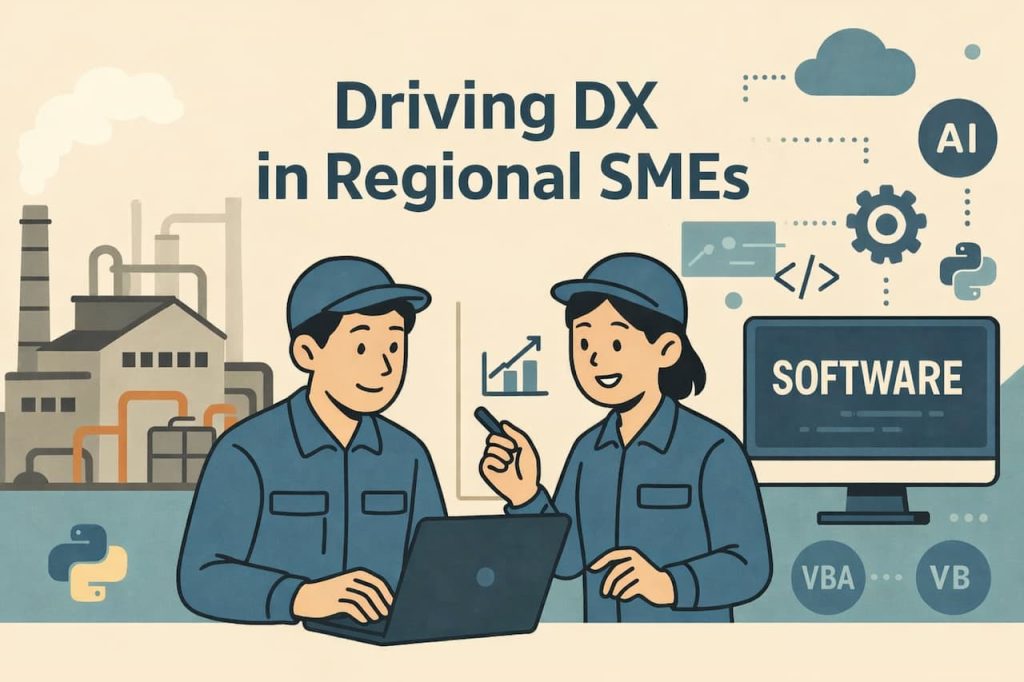
I’m Aki Matsumura, from the operational efficiency project team at Hirose Paper. I joined this company just over two months ago, coming from a background in web systems engineering. Stepping into manufacturing has been eye-opening — the backlog of things to improve, from basic digitization to full-scale DX, is enormous.
What follows is less a formal report and more a personal statement: what I believe about DX, and where I hope to take things. These are my own views, not the official position of the company. Read it as an optimistic manifesto from someone still finding their footing.
The Goal: Building a Software-Literate Organization
Day to day, I encounter plenty of small improvements worth making — better data collection, more efficient process tracking, minor automations. But the goal I’m actually working toward is much larger: building a company culture that is genuinely strong with software.
That’s not just about installing systems or going paperless. It means two things. First, that a team like mine develops real in-house software capability — the ability to build what we need, solve hard problems ourselves, and keep getting better at it. Second, that every employee becomes comfortable using digital tools and making decisions grounded in data.
We’re nowhere near that yet. But I’m convinced that without it, competing in the years ahead will be genuinely difficult — even in manufacturing.
Are You Building Software?
Mention “software development” in a manufacturing context and you’ll often get a puzzled look. The instinct is: “We make things. Software is for tech companies.” I hear it from friends and colleagues at other manufacturing firms too. “We’re a manufacturing company, so…” — and the thought trails off.
IT investment exists — ERP implementations, production management system upgrades — but it tends to happen reactively, out of necessity rather than strategic intent. Software is treated as infrastructure, not a core capability.
The problem is that this “software is someone else’s job” mindset carries real risk. In today’s business environment, software isn’t just a tool — it’s a competitive asset. Real-time production data. Digitized supplier communication. Knowledge capture that doesn’t walk out the door when someone retires. These are software-driven advantages.
“Software development” for a manufacturer doesn’t mean building the next great app. It means deeply understanding your own operations and using digital tools to evolve them. That’s the whole job.
Why Software Is Eating the World
In 2011, Marc Andreessen published an essay called “Why Software Is Eating the World.” It’s still widely cited, and for good reason — its central prediction has proven remarkably accurate.
Andreessen argued that software would “eat” traditional industries. Bookstores gave way to Amazon. Music stores to Spotify. Taxi dispatch to Uber. And in manufacturing, the optimization of production, quality, and supply chains through software is accelerating fast.
The most important insight in that essay: whoever controls the software controls the industry. No sector is exempt. The question is not whether software matters to your business — it’s how quickly you’ll adapt.
For manufacturers, the message is uncomfortable but clear. “We’re a manufacturing company” no longer excuses a passive stance toward software. That essay was written 14 years ago. Its argument is still true — and still largely unheeded.
Why a Software-First Culture Matters
DX is often understood as a project: install a system, go digital, declare victory. But that framing misses the point. Business environments change constantly. New challenges appear. A single system implementation, however well-executed, can’t keep up.
The risk of full vendor dependency is real. When a company’s technical knowledge lives entirely with outside vendors, internal staff never build the skills to evaluate, adapt, or improve their own systems. The company becomes a passive consumer of technology rather than an active user of it.
True DX requires building internal capability — people who understand software, who can participate meaningfully in system decisions, and who drive continuous improvement rather than waiting for the next vendor contract. At Hirose Paper, the backlog of software-solvable problems — quality control, environmental reporting, operational data — is long. The companies that will thrive are the ones that build the capacity to tackle those problems themselves.
AI Has Made Software Development More Accessible
Here’s the good news: the barrier to building software has never been lower. Generative AI tools like ChatGPT can now produce working code from plain-language descriptions. A basic Excel VBA macro or a simple Python script? Just explain what you need and AI will propose something usable.
This doesn’t mean the output is always optimal. But “good enough to run” can be surprisingly powerful for operational improvements — and it dramatically compresses the time from idea to working prototype.
There’s a broader shift in development philosophy here too. Rather than spending months designing a perfect system before writing a single line of code, the better approach is to ship something imperfect, learn from it, and rebuild. Version 2 will be far better than version 1. The goal isn’t to get it right the first time — it’s to move fast enough to keep learning.
This rapid cycle of build-and-discard is exactly what AI enables. And for organizations like ours, it means that increasing digital capability doesn’t require hiring a team of senior engineers. It requires a culture willing to experiment, fail quickly, and try again.
Closing
I’m still new here. The history and craftsmanship behind Japanese paper manufacturing is something I’m only beginning to understand — and the idea of weaving modern software practice into that tradition sometimes feels daunting.
But the conviction grows stronger every day. Software isn’t a disruption to work around. It’s the means by which the best of what this company already does can be amplified and shared. A step at a time, that’s what I’m here to build.
We’re early. But I’d be glad to have you along for the journey.