
New Year in Taiwan
Hi everyone! I’m H, from the sales development team. I grew up in Taiwan and lived there my whole life until I started my career. In April 2024, eager to broaden my horizons, I moved to Kochi, Japan.
Taiwan and Japan are close — not just geographically, but culturally. Living in Japan, I often stumble upon things that remind me of home. And when I visit Taiwan, I notice how much Japanese culture has left its mark there too. This cultural back-and-forth fascinates me endlessly.
Today, I’d like to share something close to my heart: how we celebrate New Year in Taiwan. I hope it gives you a glimpse into a tradition that might be both familiar and surprising.
When Is Taiwanese New Year?
Unlike Japan, which follows the Gregorian calendar for New Year, Taiwan celebrates based on the lunar calendar. That means the date shifts every year — sometimes it falls on a Monday, sometimes a Wednesday.
This creates a bit of a lottery with the holiday length. If New Year lands mid-week, the break might be short. But some years, you get a glorious nine-day stretch. Every year, there’s genuine excitement: “How many days off do we get this time?” It’s like unwrapping a small gift before the celebrations even begin.
New Year’s Eve: The Big Clean
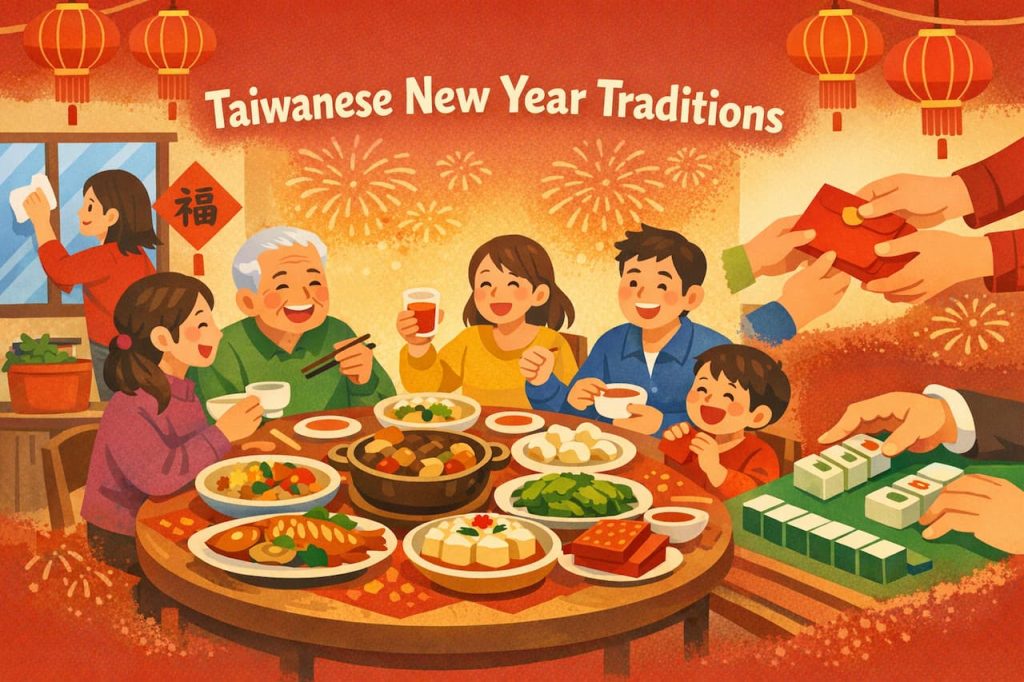
The day before New Year is called Chúxì (除夕), and just like in Japan, it’s deep-cleaning day. Every corner of the house gets attention — even the spots you’ve been conveniently ignoring all year. Window screens come off and get scrubbed. Every pane of glass gets polished.
It’s a lot of work, honestly. But there’s something satisfying about welcoming a fresh year in a spotless home. The effort feels worth it once everything gleams.
Day One: Family Reunion
The first day of the new year is all about family. Relatives gather for a big meal, everyone exchanges New Year greetings, and grandparents get to see grandchildren they might not have seen in months.
It’s loud, warm, and a little chaotic — and it’s one of the most precious moments of the entire year.
Day Two: Visiting the Wife’s Family
There’s a traditional saying in Taiwan: “Chū èr huí niáng jiā” — on the second day of the new year, a married woman returns to her parents’ home. It’s a deeply rooted custom, though modern families are much more relaxed about it now. You can visit your parents anytime.
Still, my family keeps this tradition alive. On the second day, we visit my mother’s side of the family — her parents, her siblings, and all my cousins. It’s a warm, easygoing gathering that I always look forward to.
New Year Feasts: The Best Part
If I’m being honest, the food is what I look forward to most. New Year is the one time you get to indulge in dishes that don’t appear the rest of the year.
My family typically pre-orders a set of nián cài (年菜) — special New Year dishes — from a restaurant, picks them up on New Year’s Eve, and enjoys them together at home. Like Japanese osechi, each dish carries symbolic meaning:
- Fish — represents abundance. The Chinese phrase “nián nián yǒu yú” (年年有餘) means “surplus every year,” so you deliberately leave some fish uneaten on the plate.
- Cháng nián cài (長年菜) — a long-leaf vegetable symbolizing longevity.
- Fó tiào qiáng (佛跳牆) — literally “Buddha Jumps Over the Wall,” a rich, slow-cooked soup packed with premium ingredients. The name suggests it smells so good that even a meditating monk would leap over a wall to taste it.
- Nián gāo (年糕) — sticky rice cake, symbolizing “rising higher each year,” a wish for career growth and progress.
With all this incredible food around, it’s almost impossible not to overeat. By the time the holiday ends, gaining a kilo or two is practically a tradition in itself.
Red Envelopes
Giving hóng bāo (紅包) — red envelopes filled with money — is one of the most important New Year customs. As a kid, I loved it. Parents, grandparents, aunts, uncles — everyone hands you a red envelope. The “profit margin” during childhood New Years was excellent.
Once you start working, though, the flow reverses. You don’t have to give red envelopes to all your relatives, but it’s customary to give one to your parents. It’s a way of saying thank you — a small gesture that carries real weight.
Mahjong: The Essential Pastime
No Taiwanese New Year is complete without mahjong. It’s a cornerstone of Chinese culture, and during the holidays, it becomes the default activity whenever family and friends gather. The clatter of tiles, the friendly banter, the occasional dramatic win — it’s as much a part of New Year as the food itself.
The Dreaded Relatives’ Questionnaire
There’s one part of New Year that every young person in Taiwan knows all too well: the questions. Relatives you haven’t seen in months suddenly want a full status update on your life.
- “Where are you working now?”
- “Do you have a boyfriend/girlfriend?”
- “When are you getting married?”
- “How much did you earn last year?”
- “When are you having kids?”
This is such a universal experience that it’s spawned countless memes online. If you’ve survived a family gathering anywhere in the world, you probably recognize the feeling. To everyone facing this gauntlet this year — stay strong, and good luck!