
Will AI Make Databases Obsolete?
“If AI keeps advancing, do we even need databases anymore?” I’ve been hearing this question more and more lately. And honestly, it’s not hard to see why — watching large language models evolve at this pace, it’s tempting to assume that traditional data infrastructure might just fade away.
I’ve been turning this question over in my own mind for a while. My take: databases, as a concept, are not going away anytime soon. I won’t claim they’ll last forever — some things will certainly be replaced. But “databases are unnecessary”? That’s a step too far, at least for now.
Here’s how I think about it.
A Database Is More Than a Search Engine
When AI becomes more capable, there’s a temptation to think: “AI can search anything, so why bother structuring data at all?” And yes, AI is genuinely expanding what’s possible — natural language queries, handling unstructured content, and so on.
But here’s the thing people often overlook: a database’s job isn’t only about output — retrieval and querying. The other half of the story is input.
Schema definitions, data constraints, type enforcement — these aren’t bureaucratic overhead. They’re a mechanism for declaring what counts as valid data and rejecting anything that doesn’t fit. AI is great at working with data that’s already been collected. But whether that data is correct and consistently defined in the first place? That’s a different problem entirely.
With AI agents like Claude becoming increasingly capable of handling complex workflows, AI is taking on more and more of what humans used to do. But just as disorganized data is frustrating for humans to work with, it’s equally problematic for AI. The quality of the input shapes the quality of the output — no matter how smart the system processing it.
The “Just Dump It In” Trap
Here’s a pattern I see all the time in real work: data gets collected and stored, but never properly organized. It piles up. Nobody quite knows what it means. This isn’t unusual — it’s one of the most common failure modes in data management.
What makes this tricky is that using a database doesn’t automatically protect you from this problem. If constraints and rules aren’t properly configured, the definition of your data starts to drift.
Here’s a concrete example from manufacturing. Suppose you have a table storing “work-in-progress items” — products that have been partially assembled but aren’t finished yet. Sounds straightforward, right? But if the team never agrees on exactly what qualifies as “work-in-progress” — which stage of production does it cover? which process boundary defines it? — then different people start logging records under different interpretations. The data exists. It looks fine. But the moment you try to aggregate it, you discover that records in the same table mean different things.
With spreadsheets or flat file management, this problem is even worse. Without the ability to enforce constraints, each person quietly follows slightly different rules when entering data. By the time anyone notices, the definitions have diverged completely.
Databases Enforce a Shared Definition of Reality
Think of a database schema not as a technical formality, but as the place where your team declares what data means. What values belong in this column? Is null allowed? How does this table relate to that one? Making these decisions explicit is the foundation of data quality.
The act of designing a database forces a question: “What, exactly, are we trying to store?” Sitting with that question — really working through it as a team — is what creates a shared understanding of your data. And that shared understanding is what makes AI-powered analysis or any downstream use of that data actually trustworthy.
Messy data is hard to use, for AI and humans alike. The expectation that “AI will sort it out” runs into a wall when the data it’s working with was never clearly defined to begin with. Defining data correctly, storing it correctly — this remains a fundamentally human responsibility, even in the age of AI.
That Said, Some Things Are Genuinely Changing
I’ve argued that databases aren’t going away — and I stand by that. But it would be dishonest to ignore the real shifts that are happening.
For loosely-structured information — text, documents, unstructured content — the landscape is changing fast.
RAG (Retrieval-Augmented Generation) is one well-known example: when an AI generates a response, it retrieves relevant information from an external document store or knowledge base. More recently, there’s growing interest in an approach where files are simply stored in storage and AI agents navigate them directly — using commands to locate what they need, rather than querying a structured database. Some are calling this “agent search.” For things like meeting notes, internal documents, or chat logs, this kind of AI-native retrieval is often a better fit than a traditional database. The transition away from “using a database for this kind of data” is real and already happening.
A Different Dimension: Data Without Human Interpretation
But there’s another layer to this conversation that complicates things further — an entirely different approach to data collection, one that bypasses human interpretation altogether.
In autonomous vehicles and industrial robotics, sensors capture video, audio, pressure, temperature, and sometimes even scent — and all of it gets stored. There’s no “work-in-progress definition” to agree on. No human decides what the data means. The AI handles interpretation, processing, and use entirely on its own. The philosophy is: capture everything, figure out what matters later.
This is essentially black-box data collection. It’s fundamentally different from the data model traditional databases were built around — the idea of human-defined, human-meaningful records. The data volumes are orders of magnitude larger, and the whole framework of relational database management barely applies. This is a different conversation entirely.
It’s a Spectrum, Not a Binary
After working through all of this, I keep coming back to the same conclusion: the question “will AI make databases obsolete?” can’t be answered with a simple yes or no.
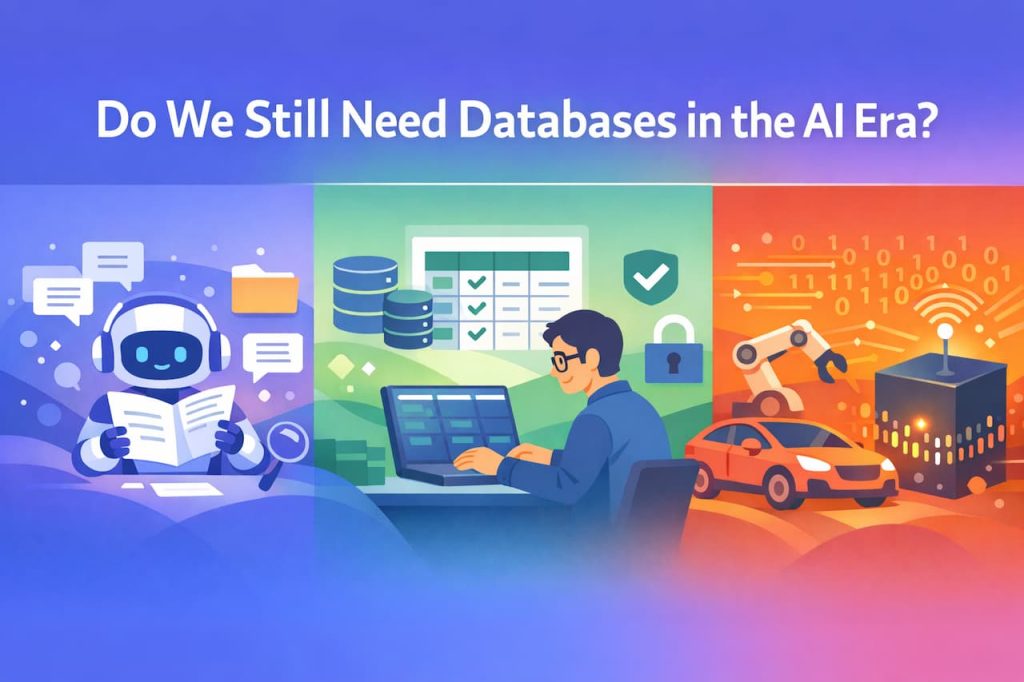
The way I see it, there are roughly three layers to how AI and data interact:
- Loosely-structured data — text, documents, informal content. The shift toward file storage and AI agent search is real and already underway.
- Formally-structured data — numbers, transactions, business logic that requires clear definitions. Human-designed databases and explicit data definitions remain essential here.
- Black-box data — sensor streams from autonomous systems. Human interpretation is removed entirely; AI handles everything. This is a different world from traditional database thinking.
The answer to “are databases necessary?” changes depending on which layer of data you’re talking about — that’s where the complexity lives.
When thinking about your own data strategy in the AI era, flattening this complexity into a simple either/or risks missing what actually matters. The better question is: what kind of data are we dealing with? Once you know where your data sits in this spectrum, the right architecture becomes much clearer.