
Three Nights on a Far-Flung Island: A Summer in Amami Oshima
The sea, my family, and a night in the village
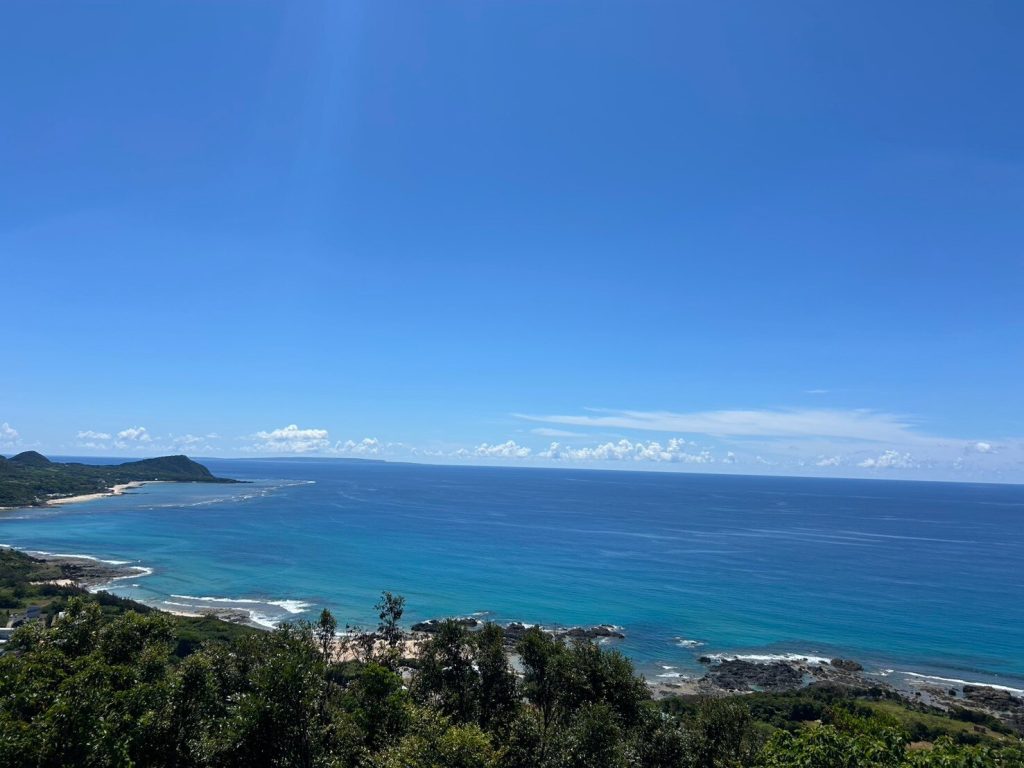
Have you ever travelled a long way from home, only to find something there that feels oddly familiar? You are far from everything you know, and yet a corner of the place seems to belong to you. That happened to me this summer.
The place was Amami Oshima, an island in Kagoshima Prefecture that sits in the stretch of ocean between Kyushu and Okinawa. Plenty of people have been to Okinawa. Far fewer stop at the islands on the way. Here is how I spent three nights there.
Visiting the son who lives on the island
My second son moved to Amami Oshima some years ago. He works for a resort development company on the island, and part of his job is converting old houses into places where guests can stay.
Because of him, our family has a rule: we go to Amami at least once a year. My wife and I have made the trip several times on our own. Bringing my eldest son’s family along, though, this was only our second time.
The group came to six: my wife and I, both of our sons, my eldest son’s wife, and our grandchild. We went at the end of July for four days and three nights, and we all stayed together in one of the old houses my second son works on — the kind that is rented out whole, to a single party, rather than by the room.
Day one: the beach, and a chef in the kitchen
We dropped our bags at the house and headed straight for the beach nearby.
The colour of the water stops you. Just past the white sand it is a clear pale green, and further out it deepens, step by step, into blue. The sea you see in photographs of southern islands was simply there in front of us.
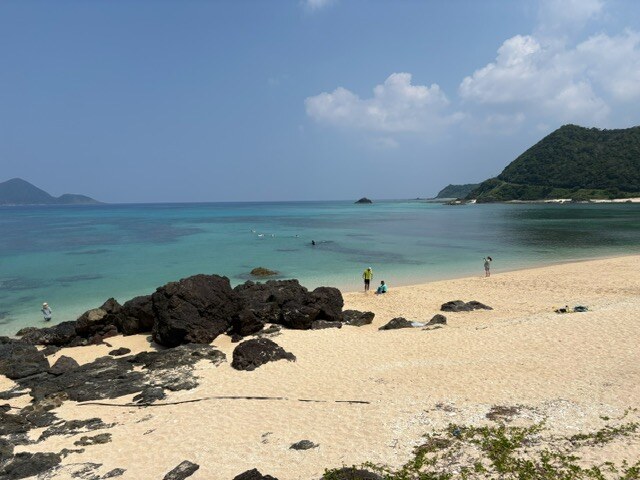
My eldest son and his wife went off snorkelling. My job was to keep an eye on my grandchild and play in the sand — which, I have to say, was not a bad assignment. Children never seem to tire of the sea.
That evening a professional chef came to the house and cooked for us there. It was a Western-style menu built from local ingredients. Island produce, prepared in a way the island itself would not — the combination was a pleasure, and we were grateful for it.
Day two: back to the beach
On the second day we went back to the beach. It was not that we ran out of ideas. Once you are standing in front of that water, no other plan makes much sense.
We did nothing at all that day. Sit on the sand, look at the sea, walk a little, sit down again — with my grandchild playing at the waterline in the corner of my eye. One day with nothing in the diary and the whole trip slows down.
Why is the water so clear, though? I looked it up afterwards, and it made sense. The coral reef ringing the island absorbs plankton and organic matter, filtering the water as it goes. That transparency is made by the shape of the island itself.
Now that I think of it, in the shallows I could stand and still see the sand under my feet. A little further out, they say, you find coral scattered across the seabed and bright fish gathered around it. No wonder my eldest son and his wife were so keen to get their masks on.
What struck me was how quiet the beach was. Compared with Okinawa, Amami Oshima has not been built up for tourism to anything like the same degree. The sand was not crowded. People came and went, but not many.
The sea is every bit as beautiful, and yet the mood is far calmer. That quiet suited me.
Day three: sea turtles, and a game after dark
Feeding the sea turtles
On the third day we drove my eldest son and his wife to the airport. Our group got a little smaller.
Afterwards I took my grandchild to the Amami Marine Exhibition Hall (Japanese only), inside Ohama Seaside Park in Amami City, where you can see the creatures that live in the waters around the island.
The draw here is that you can feed the sea turtles yourself. The food is lettuce. My grandchild held a leaf out and a turtle came slowly over for it, which was evidently good fun — my grandchild looked thoroughly pleased.
Not through glass, but at arm’s length: a living creature, right there. For a child, I think that distance is what matters.
The hall also has a large tank called the Amami Ecorama, which recreates the underwater terrain around the island, along with a touch pool where you can handle sea cucumbers and a whale skeleton on display. We fed the turtles, glanced around the entrance, and left — so if you want to see it properly, give yourself more time than we did.
Nanko, in the village that night
Then came the evening. The village had a gathering, they let me join, and I found myself playing a game called nanko.
Nanko is an old drinking game from Amami and the wider Kagoshima region. Two players sit facing each other, each holding three short wooden sticks. You put both hands behind your back, close some number of sticks into your fist without letting your opponent see, and then thrust that fist out over a small wooden board. The object is to guess how many sticks the other person is holding. The game is said to date back to the late 1500s (Japanese only), when Shimazu Yoshihiro brought it home from the campaigns in Korea.
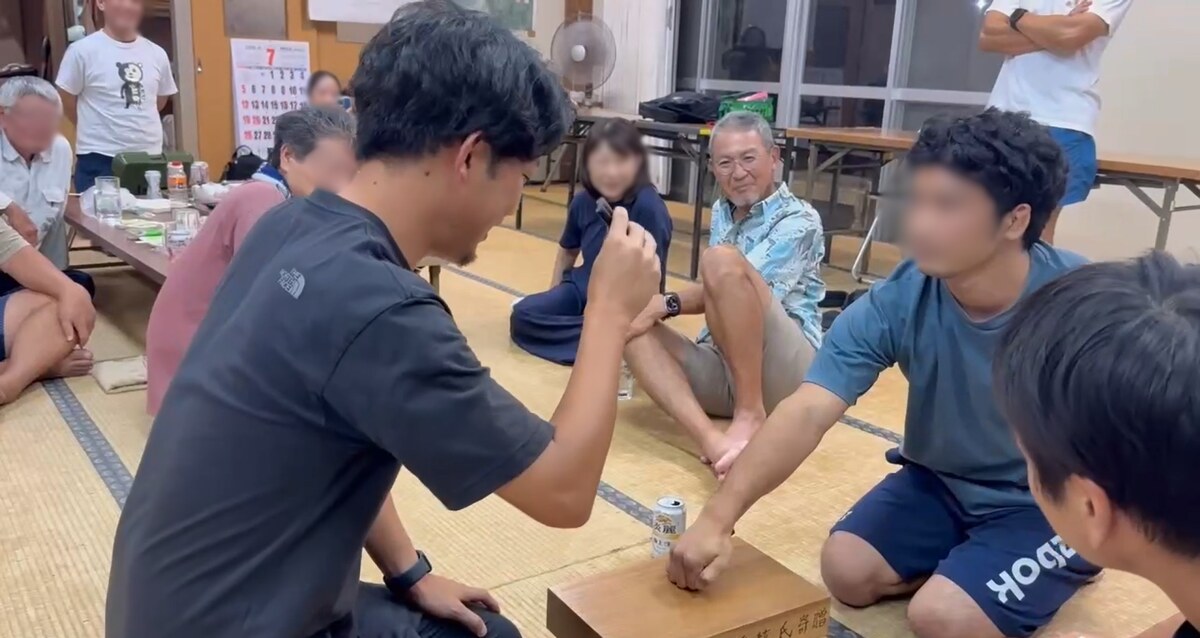
Something like thirty villagers had turned out. I took a seat and played, and I found it harder than it looks. Guessing the number is only half of it — there is a call-and-response that goes with each throw, and it is spoken in the island dialect. My mouth could not keep up.
The people around me taught me patiently all the same. Nobody minded that I was bad at it; they simply kept me in the circle. You do not need the words to belong to the evening — that was the feeling I came away with.
One note, in case you have read about nanko elsewhere: some accounts describe it as a game where the loser has to drink. There was no such forfeit at this gathering. We played for the game itself. The brown sugar shochu went round regardless.
Surely this is hashiken
Somewhere in the middle of a round it struck me. This is hashiken — the game we play back home in Kochi.
For readers who have not met it: hashiken is played with three chopsticks each, held out of sight, with the two players reading how many chopsticks are in play between them. The guessing works a little differently (in nanko you name your opponent’s count; in hashiken you play so the total comes to three). But three implements, a hidden hand, a number to be guessed, and a drink on the table — that feels like too much overlap to put down to coincidence.
Amami is the home of kokuto shochu (Japanese only), a distilled spirit made from brown sugar that, by law, may only be produced in the Amami Islands. The village gathers, drinks, and dances. Kochi, far to the north on the island of Shikoku, is likewise a place that takes its drinking seriously — and its drinking comes with hashiken (Japanese only). Two places, and in both of them a game grew up around the cup.
There was one more thing I noticed that night. My son came to the island from outside, and yet he has been absorbed into the village and made welcome there. They open the circle to outsiders. I was glad to stand inside it for an evening.
Day four: the Oshima Tsumugi Village
On the last day my wife and I went to Oshima Tsumugi Village (Japanese only) in the town of Tatsugo, where you can watch Oshima tsumugi — the silk fabric the island is known for — being made.
You can try the dyeing yourself, but this time we simply walked through and watched. The shimebata, the frame that binds the resist pattern into the silk thread. The dyeing with a colour drawn from the wood of the sharinbai tree. And then the mud dyeing. So that, I thought, is where the depth of that black comes from.
Last comes the weaving by hand. Watching a weaver line up point against tiny point, you can see with your own eyes how many hands a single bolt of cloth passes through. Some things, it seems, you only take in by standing in the workshop and looking.
What I brought home
If I had to describe the island in one word, the closest I can get is unpolished — and I mean that as praise. The sea is beautiful, of course. But the towns are plain, and so are the people. Kind, easy to talk to, nothing put on for show.
I also came home feeling that Kochi and Amami Oshima are not so far apart. Perhaps warm places have something in common. The drinking games are probably just the most obvious sign of it.
Amami is an island, though, and Kochi is not. It has the beaches, the coral, the untouched green. Set against Okinawa it is quieter and more plain-spoken, and to my mind that is exactly what recommends it.
Amami Oshima is a very good place. If you have already made it as far as Okinawa, consider stopping at the island that comes before it. You may find yourself startled by the colour of the water — and then catching, somewhere, the scent of somewhere else you know.